In applied mathematics, specifically in fuzzy logic, the ordered weighted averaging (OWA) operators provide a parameterized class of mean type aggregation operators. They were introduced by Ronald R. Yager. Many notable mean operators such as the max, arithmetic average, median and min, are members of this class. They have been widely used in computational intelligence because of their ability to model linguistically expressed aggregation instructions. == Definition == An OWA operator of dimension n {\displaystyle \ n} is a mapping F : R n → R {\displaystyle F:\mathbb {R} ^{n}\rightarrow \mathbb {R} } that has an associated collection of weights W = [ w 1 , … , w n ] {\displaystyle \ W=[w_{1},\ldots ,w_{n}]} lying in the unit interval and summing to one and with F ( a 1 , … , a n ) = ∑ j = 1 n w j b j {\displaystyle F(a_{1},\ldots ,a_{n})=\sum _{j=1}^{n}w_{j}b_{j}} where b j {\displaystyle b_{j}} is the jth largest of the a i {\displaystyle a_{i}} . By choosing different W one can implement different aggregation operators. The OWA operator is a non-linear operator as a result of the process of determining the bj. == Notable OWA operators == F ( a 1 , … , a n ) = max ( a 1 , … , a n ) {\displaystyle \ F(a_{1},\ldots ,a_{n})=\max(a_{1},\ldots ,a_{n})} if w 1 = 1 {\displaystyle \ w_{1}=1} and w j = 0 {\displaystyle \ w_{j}=0} for j ≠ 1 {\displaystyle j\neq 1} F ( a 1 , … , a n ) = min ( a 1 , … , a n ) {\displaystyle \ F(a_{1},\ldots ,a_{n})=\min(a_{1},\ldots ,a_{n})} if w n = 1 {\displaystyle \ w_{n}=1} and w j = 0 {\displaystyle \ w_{j}=0} for j ≠ n {\displaystyle j\neq n} F ( a 1 , … , a n ) = a v e r a g e ( a 1 , … , a n ) {\displaystyle \ F(a_{1},\ldots ,a_{n})=\mathrm {average} (a_{1},\ldots ,a_{n})} if w j = 1 n {\displaystyle \ w_{j}={\frac {1}{n}}} for all j ∈ [ 1 , n ] {\displaystyle j\in [1,n]} == Properties == The OWA operator is a mean operator. It is bounded, monotonic, symmetric, and idempotent, as defined below. == Characterizing features == Two features have been used to characterize the OWA operators. The first is the attitudinal character, also called orness. This is defined as A − C ( W ) = 1 n − 1 ∑ j = 1 n ( n − j ) w j . {\displaystyle A-C(W)={\frac {1}{n-1}}\sum _{j=1}^{n}(n-j)w_{j}.} It is known that A − C ( W ) ∈ [ 0 , 1 ] {\displaystyle A-C(W)\in [0,1]} . In addition A − C(max) = 1, A − C(ave) = A − C(med) = 0.5 and A − C(min) = 0. Thus the A − C goes from 1 to 0 as we go from Max to Min aggregation. The attitudinal character characterizes the similarity of aggregation to OR operation(OR is defined as the Max). The second feature is the dispersion. This defined as H ( W ) = − ∑ j = 1 n w j ln ( w j ) . {\displaystyle H(W)=-\sum _{j=1}^{n}w_{j}\ln(w_{j}).} An alternative definition is E ( W ) = ∑ j = 1 n w j 2 . {\displaystyle E(W)=\sum _{j=1}^{n}w_{j}^{2}.} The dispersion characterizes how uniformly the arguments are being used. == Type-1 OWA aggregation operators == The above Yager's OWA operators are used to aggregate the crisp values. Can we aggregate fuzzy sets in the OWA mechanism? The Type-1 OWA operators have been proposed for this purpose. So the type-1 OWA operators provides us with a new technique for directly aggregating uncertain information with uncertain weights via OWA mechanism in soft decision making and data mining, where these uncertain objects are modelled by fuzzy sets. The type-1 OWA operator is defined according to the alpha-cuts of fuzzy sets as follows: Given the n linguistic weights { W i } i = 1 n {\displaystyle \left\{{W^{i}}\right\}_{i=1}^{n}} in the form of fuzzy sets defined on the domain of discourse U = [ 0 , 1 ] {\displaystyle U=[0,\;\;1]} , then for each α ∈ [ 0 , 1 ] {\displaystyle \alpha \in [0,\;1]} , an α {\displaystyle \alpha } -level type-1 OWA operator with α {\displaystyle \alpha } -level sets { W α i } i = 1 n {\displaystyle \left\{{W_{\alpha }^{i}}\right\}_{i=1}^{n}} to aggregate the α {\displaystyle \alpha } -cuts of fuzzy sets { A i } i = 1 n {\displaystyle \left\{{A^{i}}\right\}_{i=1}^{n}} is given as Φ α ( A α 1 , … , A α n ) = { ∑ i = 1 n w i a σ ( i ) ∑ i = 1 n w i | w i ∈ W α i , a i ∈ A α i , i = 1 , … , n } {\displaystyle \Phi _{\alpha }\left({A_{\alpha }^{1},\ldots ,A_{\alpha }^{n}}\right)=\left\{{{\frac {\sum \limits _{i=1}^{n}{w_{i}a_{\sigma (i)}}}{\sum \limits _{i=1}^{n}{w_{i}}}}\left|{w_{i}\in W_{\alpha }^{i},\;a_{i}}\right.\in A_{\alpha }^{i},\;i=1,\ldots ,n}\right\}} where W α i = { w | μ W i ( w ) ≥ α } , A α i = { x | μ A i ( x ) ≥ α } {\displaystyle W_{\alpha }^{i}=\{w|\mu _{W_{i}}(w)\geq \alpha \},A_{\alpha }^{i}=\{x|\mu _{A_{i}}(x)\geq \alpha \}} , and σ : { 1 , … , n } → { 1 , … , n } {\displaystyle \sigma :\{\;1,\ldots ,n\;\}\to \{\;1,\ldots ,n\;\}} is a permutation function such that a σ ( i ) ≥ a σ ( i + 1 ) , ∀ i = 1 , … , n − 1 {\displaystyle a_{\sigma (i)}\geq a_{\sigma (i+1)},\;\forall \;i=1,\ldots ,n-1} , i.e., a σ ( i ) {\displaystyle a_{\sigma (i)}} is the i {\displaystyle i} th largest element in the set { a 1 , … , a n } {\displaystyle \left\{{a_{1},\ldots ,a_{n}}\right\}} . The computation of the type-1 OWA output is implemented by computing the left end-points and right end-points of the intervals Φ α ( A α 1 , … , A α n ) {\displaystyle \Phi _{\alpha }\left({A_{\alpha }^{1},\ldots ,A_{\alpha }^{n}}\right)} : Φ α ( A α 1 , … , A α n ) − {\displaystyle \Phi _{\alpha }\left({A_{\alpha }^{1},\ldots ,A_{\alpha }^{n}}\right)_{-}} and Φ α ( A α 1 , … , A α n ) + , {\displaystyle \Phi _{\alpha }\left({A_{\alpha }^{1},\ldots ,A_{\alpha }^{n}}\right)_{+},} where A α i = [ A α − i , A α + i ] , W α i = [ W α − i , W α + i ] {\displaystyle A_{\alpha }^{i}=[A_{\alpha -}^{i},A_{\alpha +}^{i}],W_{\alpha }^{i}=[W_{\alpha -}^{i},W_{\alpha +}^{i}]} . Then membership function of resulting aggregation fuzzy set is: μ G ( x ) = ∨ α : x ∈ Φ α ( A α 1 , ⋯ , A α n ) α α {\displaystyle \mu _{G}(x)=\mathop {\vee } _{\alpha :x\in \Phi _{\alpha }\left({A_{\alpha }^{1},\cdots ,A_{\alpha }^{n}}\right)_{\alpha }}\alpha } For the left end-points, we need to solve the following programming problem: Φ α ( A α 1 , ⋯ , A α n ) − = min W α − i ≤ w i ≤ W α + i A α − i ≤ a i ≤ A α + i ∑ i = 1 n w i a σ ( i ) / ∑ i = 1 n w i {\displaystyle \Phi _{\alpha }\left({A_{\alpha }^{1},\cdots ,A_{\alpha }^{n}}\right)_{-}=\min \limits _{\begin{array}{l}W_{\alpha -}^{i}\leq w_{i}\leq W_{\alpha +}^{i}A_{\alpha -}^{i}\leq a_{i}\leq A_{\alpha +}^{i}\end{array}}\sum \limits _{i=1}^{n}{w_{i}a_{\sigma (i)}/\sum \limits _{i=1}^{n}{w_{i}}}} while for the right end-points, we need to solve the following programming problem: Φ α ( A α 1 , ⋯ , A α n ) + = max W α − i ≤ w i ≤ W α + i A α − i ≤ a i ≤ A α + i ∑ i = 1 n w i a σ ( i ) / ∑ i = 1 n w i {\displaystyle \Phi _{\alpha }\left({A_{\alpha }^{1},\cdots ,A_{\alpha }^{n}}\right)_{+}=\max \limits _{\begin{array}{l}W_{\alpha -}^{i}\leq w_{i}\leq W_{\alpha +}^{i}A_{\alpha -}^{i}\leq a_{i}\leq A_{\alpha +}^{i}\end{array}}\sum \limits _{i=1}^{n}{w_{i}a_{\sigma (i)}/\sum \limits _{i=1}^{n}{w_{i}}}} Zhou et al. presented a fast method to solve two programming problem so that the type-1 OWA aggregation operation can be performed efficiently. == OWA for committee voting == Amanatidis, Barrot, Lang, Markakis and Ries present voting rules for multi-issue voting, based on OWA and the Hamming distance. Barrot, Lang and Yokoo study the manipulability of these rules.
Quack.com
Quack.com was an early voice portal company. The domain name later was used for Quack, an iPad search application from AOL. == History == It was founded in 1998 by Steven Woods, Jeromy Carriere and Alex Quilici as a Pittsburgh, Pennsylvania, USA, based voice portal infrastructure company named Quackware. Quack was the first company to try to create a voice portal: a consumer-based destination "site" in which consumers could not only access information by voice alone, but also complete transactions. Quackware launched a beta phone service in 1999 that allowed consumers to purchase books from sites such as Amazon and CDs from sites such as CDNow by answering a short set of questions. Quack followed with a set of information services from movie listings (inspired by, but expanding upon, Moviefone) to news, weather and stock quotes. This concept introduced a series of lookalike startups including Tellme Networks which raised more money than any Internet startup in history on a similar concept. Quack received its first venture funding from HDL Capital in 1999 and moved operations to Mountain View in Silicon Valley, California in 1999. A deal with Lycos was announced in May 2000. In September 2000 Quack was acquired for $200 million by America Online (AOL) and moved onto the Netscape campus with what was left of the Netscape team. Quack was attacked in the Canadian press for being representative of the Canadian "brain drain" to the US during the Internet bubble, focusing its recruiting efforts on the University of Waterloo, hiring more than 50 engineers from Waterloo in less than 10 months. Quack competitor Tellme Networks raised enormous funds in what became a highly competitive market in 2000, with the emergence of more than a dozen additional competitors in a 12-month period. Following its acquisition by America Online in an effort led by Ted Leonsis to bring Quack into AOL Interactive, the Quack voice service became AOLbyPhone as one of AOL's "web properties" along with MapQuest, Moviefone and others. Quack secured several patents that underlie the technical challenges of delivering interactive voice services. Constructing a voice portal required integrations and innovations not only in speech recognition and speech generation, but also in databases, application specification, constraint-based reasoning and artificial intelligence and computational linguistics. "Quack"'s name derived from the company goal of providing not only voice-based services, but more broadly "Quick Ubiquitous Access to Consumer Knowledge". The patents assigned to Quack.com include: System and method for voice access to Internet-based information, System and method for advertising with an Internet Voice Portal and recognizing the axiom that in interactive voice systems one must "know the set of possible answers to a question before asking it". System and method for determining if one web site has the same information as another web site. Quack.com was spoofed in The Simpsons in March 2002 in the episode "Blame It on Lisa" in which a "ComQuaak" sign is replaced by another equally crazy telecom company name. == 2010 onwards == In July 2010, quack.com became the focus of a new AOL iPad application, that was a web search experience. The product delivers web results and blends in picture, video and Twitter results. It enables you to preview the web results before you go to the site, search within each result, and flip through the results pages, making full use of the iPad's touch screen features. The iPad app was free via iTunes, but support discontinued in 2012.
Gallery software
Gallery software is software that helps the user publish or share photos, pictures, videos or other digital media. Most galleries are located on Web servers, where users are allowed to register and publish their pictures. Gallery software usually features automatic image resizing, allows digital media be categorized into sets, and allows comments. == Types == Early digital media publishing and sharing was done with imageboards. The boards are by topics, sometimes called "chan". Each discussion in a "chan" are started with a piece of digital media, and follow-up discussions can contain another piece too. Software works in this way: Futallaby, Danbooru. Traditionally, galleries are managed. An administrator maintains a set of or hierarchy of albums. The users can upload their digital media in one of the existing albums defined by an administrator, or create their own albums. The users with sufficient permission can re-categorise the digital media others uploaded. Often, the site's administrator can define which album the users are allowed to categorise their media into, or delete other user's content. Examples are open source galleries Coppermine, Gallery Project. There are decentralised gallery software that does not have an administrator for managing contents. Pinterest, Flickr and DeviantArt has been successful with this model. Open source gallery software MediaGoblin works in this way. Each user can create their own "collections", to categorise theirs or other users' media. However users cannot put media into other user's collections. Each user's category is separate. There is no centralised theme or hierarchy for the media.
Alice AI (AI model family)
Alice AI is a neural network family developed by the Russian company Yandex LLC. Alice AI can create and revise texts, generate new ideas and capture the context of the conversation with the user. Alice AI is trained using a dataset which includes information from books, magazines, newspapers and other open sources available on the internet. The neural network may get facts wrong and hallucinate, but as it learns, it will produce increasingly accurate answers. == Usage == YandexGPT is integrated into virtual assistant Alice (an analog of Siri and Alexa) and is available in Yandex services and applications. The company gives businesses access to the neural network’s API through the public cloud platform Yandex Cloud and develops its own B2B solutions on its basis. Since July 2023, 800 companies have participated in the closed testing of YandexGPT. IT developers, banks, retail businesses, and companies from other industries can use the technology in two modes — API and Playground (an interface in the Yandex Cloud console for testing models and hypotheses). Two model versions are available to businesses: one works in asynchronous mode and is better able to handle complex tasks, while the other is suitable for creating quick responses in real time. As a result, YandexGPT has been tested in dozens of scenarios such as content tasks, tech support, creating chatbots, virtual assistants, etc. == History == In February 2023, Yandex announced that it was working on its own version of the ChatGPT generative neural network while developing a language model from the YaLM (Yet another Language Model) family. The project was tentatively named YaLM 2.0, which was later changed to YandexGPT. On May 17, the company unveiled a neural network called YandexGPT (YaGPT) and enabled its virtual assistant Alice to interact with the new language model. On June 15, 2023, Yandex added the YandexGPT language model to the image generation application Shedevrum. This enabled its users to create fully-fledged posts complete with a title, text, and relevant illustration. In July 2023, YandexGPT launched new features enabling businesses to create virtual assistants and chatbots, as well as generate and structure texts. On September 7, 2023, Yandex presented a new version of the language model, YandexGPT 2, at the Practical ML Conf. Compared to the previous one, the new version is able to perform more types of tasks, and the quality of answers has improved. The developers claimed that YandexGPT 2 answered user questions better than the first version in 67% of cases. From October 6, 2023, YandexGPT can create short retellings of online Russian-language videos on the Internet. It can summarize videos that are from two minutes to four hours long and contain speech.
Spleak
Spleak was an IM platform where users could publish and rate content. It existed in the form of six bots covering as many subject areas: CelebSpleak, SportSpleak, VoteSpleak, TVSpleak, GameSpleak, and StyleSpleak. == Overview == Users can add a "multi-Spleak" (which contains all of the different Spleak bots in one) or add the separate bots to their IM buddy lists on MSN and AIM. Users are also allowed access to Spleak online by using a CelebSpleak, SportSpleak, or VoteSpleak widget, or through the CelebSpleak and SportSpleak applications with Facebook. Spleak was an alternate reality game and is moving to its own company, Spleak Media Network. "Celebrate Spleak" was introduced throughout 2007, launched in 2008, and was forced to retire in 2009. == Key people == Spleak was co-founded by Morten Lund and Nicolaj Reffstrup. The company's chief executive officer is Morrie Eisenburg; Josh Scott is Vice President in Product and Tyler Wells is Vice President in Engineering.
PlantUML
PlantUML is an open-source tool allowing users to create diagrams from a plain text language. Besides various UML diagrams, PlantUML has support for various other software development related formats (such as Archimate, Block diagram, BPMN, C4, Computer network diagram, ERD, Gantt chart, Mind map, and WBD), as well as visualisation of JSON and YAML files. The language of PlantUML is an example of a domain-specific language. Besides its own DSL, PlantUML also understands AsciiMath, Creole, DOT, and LaTeX. It uses Graphviz software to lay out its diagrams and Tikz for LaTeX support. Images can be output as PNG, SVG, LaTeX and even ASCII art. PlantUML has also been used to allow blind people to design and read UML diagrams. == Applications that use PlantUML == There are various extensions or add-ons that incorporate PlantUML. Atom has a community maintained PlantUML syntax highlighter and viewer. Confluence wiki has a PlantUML plug-in for Confluence Server, which renders diagrams on-the-fly during a page reload. There is an additional PlantUML plug-in for Confluence Cloud. Doxygen integrates diagrams for which sources are provided after the startuml command. Eclipse has a PlantUML plug-in. Google Docs has an add-on called PlantUML Gizmo that works with the PlantUML.com server. IntelliJ IDEA can create and display diagrams embedded into Markdown (built-in) or in standalone files (using a plugin). LaTeX using the Tikz package has limited support for PlantUML. LibreOffice has Libo_PlantUML extension to use PlantUML diagrams. MediaWiki has a PlantUML plug-in which renders diagrams in pages as SVG or PNG. Microsoft Word can use PlantUML diagrams via a Word Template Add-in. There is an additional Visual Studio Tools for Office add-in called PlantUML Gizmo that works in a similar fashion. NetBeans has a PlantUML plug-in. Notepad++ has a PlantUML plug-in. Obsidian has a PlantUML plug-in. Org-mode has a PlantUML org-babel support. Rider has a PlantUML plug-in. Sublime Text has a PlantUML package called PlantUmlDiagrams for Sublime Text 2 and 3. Visual Studio Code has various PlantUML extensions on its marketplace, most popular being PlantUML by jebbs. Vnote open source notetaking markdown application has built in PlantUML support. Xcode has a community maintained Source Editor Extension to generate and view PlantUML class diagrams from Swift source code. == Text format to communicate UML at source code level == PlantUML uses well-formed and human-readable code to render the diagrams. There are other text formats for UML modelling, but PlantUML supports many diagram types, and does not need an explicit layout, though it is possible to tweak the diagrams if necessary. +--------------------------------------+ | TEDx Talks Recommendation | | System | +--------------------------------------+ | +----------------------------------+ | | | Visitor | | | +----------------------------------+ | | | + View Recommended Talks | | | | + Search Talks | | | +----------------------------------+ | +--------------------------------------+ | | V +--------------------------------------+ | Authenticated User | +--------------------------------------+ | +----------------------------------+ | | | User | | | +----------------------------------+ | | | + View Recommended Talks | | | | + Search Talks | | | | + Save Favorite Talks | | | +----------------------------------+ | +--------------------------------------+ | | V +--------------------------------------+ | Admin | +--------------------------------------+ | +----------------------------------+ | | | Admin | | | +----------------------------------+ | | | + CRUD Talks | | | | + Manage Users | | | +----------------------------------+ | +--------------------------------------+
Chatbot
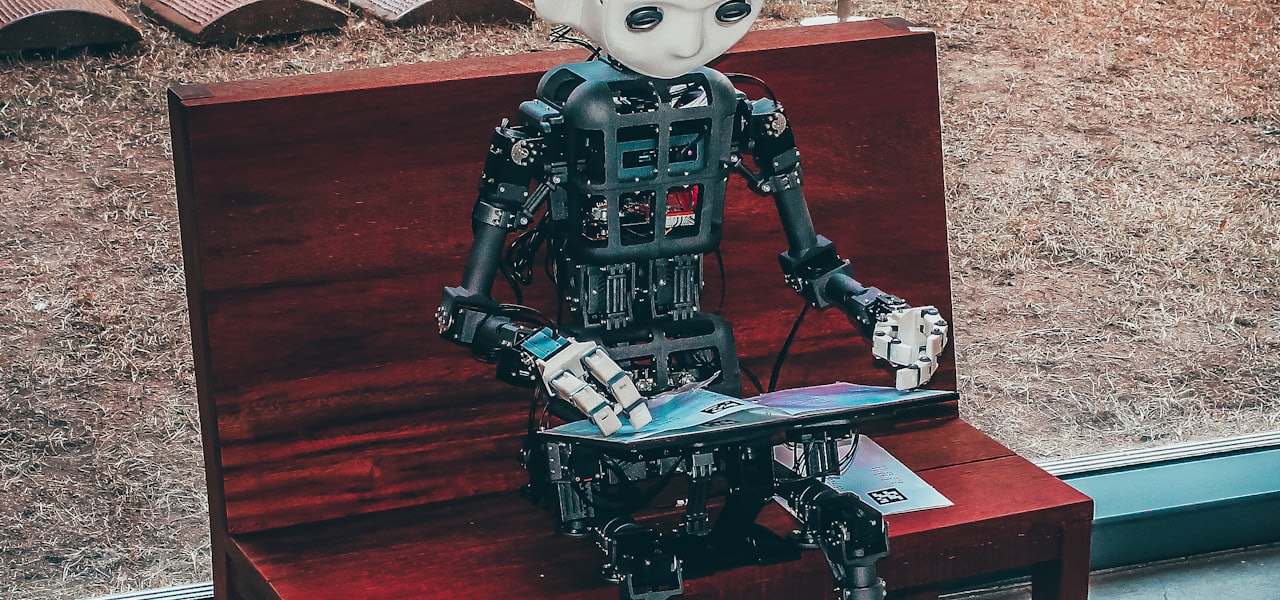
A chatbot (originally chatterbot) is a software application or web interface designed to converse through text or speech. Modern chatbots are typically online and use generative artificial intelligence systems that are capable of maintaining a conversation with a user in natural language and simulating the way a human would behave as a conversational partner. Such chatbots often use deep learning and natural language processing. Simpler chatbots have existed for decades. Chatbots have gained popularity during the AI boom of the 2020s, with the releases of generative AI chatbots such as ChatGPT, Gemini, Claude, and Grok. These chatbots typically use fine-tuned large language models to generate text. A major area where chatbots have long been used is customer service and support, with various sorts of virtual assistants. == History == === Turing test === In 1950, Alan Turing published an article entitled "Computing Machinery and Intelligence" in which he proposed what is now called the Turing test as a criterion of intelligence. This criterion depends on the ability of a computer program to impersonate a human in a real-time written conversation with a human judge, to the extent that the judge is incapable of reliably distinguishing, on the basis of the conversational content alone, between the program and a real human. === Early chatbots === Joseph Weizenbaum's program ELIZA was first published in 1966. Weizenbaum did not claim that ELIZA was genuinely intelligent, and the introduction to his paper presented it more as a debunking exercise:In artificial intelligence, machines are made to behave in wondrous ways, often sufficient to dazzle even the most experienced observer. But once a particular program is unmasked, once its inner workings are explained, its magic crumbles away; it stands revealed as a mere collection of procedures. The observer says to himself "I could have written that". With that thought, he moves the program in question from the shelf marked "intelligent", to that reserved for curios. The object of this paper is to cause just such a re-evaluation of the program about to be "explained". Few programs ever needed it more. ELIZA's key method of operation involves the recognition of clue words or phrases in the input, and the output of the corresponding pre-prepared or pre-programmed responses that can move the conversation forward in an apparently meaningful way (e.g. by responding to any input that contains the word 'MOTHER' with 'TELL ME MORE ABOUT YOUR FAMILY'). Thus an illusion of understanding is generated, even though the processing involved has been merely superficial. ELIZA showed that such an illusion is surprisingly easy to generate because human judges are ready to give the benefit of the doubt when conversational responses are capable of being interpreted as "intelligent". Following ELIZA, psychiatrist Kenneth Colby developed PARRY in 1972. From 1978 to some time after 1983, the CYRUS project led by Janet Kolodner constructed a chatbot simulating Cyrus Vance (57th United States Secretary of State). It used case-based reasoning, and updated its database daily by parsing wire news from United Press International. The program was unable to process the news items subsequent to the surprise resignation of Cyrus Vance in April 1980, and the team constructed another chatbot simulating his successor, Edmund Muskie. In 1984, an interactive version of the program Racter was released which acted as a chatbot. A.L.I.C.E. was released in 1995. This uses a markup language called AIML, which is specific to its function as a conversational agent, and has since been adopted by various other developers of, so-called, Alicebots. A.L.I.C.E. is a weak AI without any reasoning capabilities. It is based on a similar pattern matching technique as ELIZA in 1966. This is not strong AI, which would require sapience and logical reasoning abilities. Jabberwacky, released in 1997, learns new responses and context based on real-time user interactions, rather than being driven from a static database. Chatbot competitions focus on the Turing test or more specific goals. Two such annual contests are the Loebner Prize and The Chatterbox Challenge (the latter has been offline since 2015, however, materials can still be found from web archives). Pre-dating the current generation of large language models, Gavagai, a Swedish language technology startup, created a Twitter-based bot in 2015 and DBpedia created a chatbot during the 2017 Google Summer of Code that communicated through Facebook Messenger. === Modern chatbots based on large language models === Modern chatbots like ChatGPT are often based on foundational large language models called generative pre-trained transformers (GPT). They are based on a deep learning architecture called the transformer, which contains artificial neural networks. They generate text after being trained on a large text corpus, and have emergent abilities that they are not specifically trained for. Chatbots integrated into apps and websites can call image-generation models or search the web. Some platforms also enable users to interact with conversational interfaces directly through web-based chat environments, allowing real-time assistance, content generation, and task automation without requiring software installation. == Application == === Messaging apps === Many companies' chatbots run on messaging apps or simply via SMS. They are used for B2C customer service, sales and marketing. In 2016, Facebook Messenger allowed developers to place chatbots on their platform. There were 30,000 bots created for Messenger in the first six months, rising to 100,000 by September 2017. Since September 2017, this has also been as part of a pilot program on WhatsApp. Airlines KLM and Aeroméxico both announced their participation in the testing; both airlines had previously launched customer services on the Facebook Messenger platform. The bots usually appear as one of the user's contacts, but can sometimes act as participants in a group chat. Many banks, insurers, media companies, e-commerce companies, airlines, hotel chains, retailers, health care providers, government entities, and restaurant chains have used chatbots to answer simple questions, increase customer engagement, for promotion, and to offer additional ways to order from them. Chatbots are also used in market research to collect short survey responses. A 2017 study showed 4% of companies used chatbots. In a 2016 study, 80% of businesses said they intended to have one by 2020. ==== As part of company apps and websites ==== Previous generations of chatbots were present on company websites, e.g. Ask Jenn from Alaska Airlines which debuted in 2008 or Expedia's virtual customer service agent which launched in 2011. The newer generation of chatbots includes IBM Watson-powered "Rocky", introduced in February 2017 by the New York City-based e-commerce company Rare Carat to provide information to prospective diamond buyers. ==== Chatbot sequences ==== Used by marketers to script sequences of messages, very similar to an autoresponder sequence. Such sequences can be triggered by user opt-in or the use of keywords within user interactions. After a trigger occurs a sequence of messages is delivered until the next anticipated user response. Each user response is used in the decision tree to help the chatbot navigate the response sequences to deliver the correct response message. === Company internal platforms === Companies have used chatbots for customer support, human resources, or in Internet-of-Things (IoT) projects. Overstock.com, for one, has reportedly launched a chatbot named Mila to attempt to automate certain processes when customer service employees request sick leave. Other large companies such as Lloyds Banking Group, Royal Bank of Scotland, Renault and Citroën are now using chatbots instead of call centres with humans to provide a first point of contact. In large companies, like in hospitals and aviation organizations, chatbots are also used to share information within organizations, and to assist and replace service desks. === Customer service === Chatbots have been proposed as a replacement for customer service departments. In 2026, The Financial Times reported on agentic chatbots that could do shopping for customers once given instructions. In 2016, Russia-based Tochka Bank launched a chatbot on Facebook for a range of financial services, including a possibility of making payments. In July 2016, Barclays Africa also launched a Facebook chatbot. === Healthcare === Chatbots are also appearing in the healthcare industry. A study suggested that physicians in the United States believed that chatbots would be most beneficial for scheduling doctor appointments, locating health clinics, or providing medication information. A 2025 review found that participants often rated chatbot responses as more empathic than those from clinicians. In 2020, WhatsApp worked with th